


When we use celery in the kitchen, we are used to focusing mostly on the stalks, while the leaves often end up in the trash. Actually Celery leaves are edible, aromatic, and rich in flavor and they can be used in many preparations, from the simplest recipes to dressings.
Their flavor is intense and slightly more robust than that of the stalk, a characteristic that makes them perfect for flavoring dishes, preparing sauces and pesto, or becoming the star of creative recipes.
Discover how to use celery leaves in the kitchen with 5 simple and tasty recipes and give new life to a part of the vegetable that is too often wasted.
Can celery leaves be eaten?
Yes, Celery leaves are edible and they can be used just like the rest of the vegetable. They have an aromatic and intense flavor and, thanks to their more delicate texture compared to the stalks, they can be eaten both raw and cooked.
The more tender leaves are particularly suitable for adding to salads, sauces, and dressings, while the slightly firmer ones can be used to prepare broths, soups, omelets, and other recipes.
Before using them, it is important to select the leaves: discard the withered, yellowed or damaged ones and keep the fresh, green and intact ones.
Zero Waste Tip: when you buy a bunch of celery, do not automatically separate the leaves from the stalks to then throw them away. You can store them together and decide later how to use them, turning them into a real ingredient.
Leaves and stems of celery: what is the difference?
Celery is a particularly versatile vegetable because every part of it can find a use in cooking.
I celery stalks They have a crunchy texture and a fresh, aromatic flavor. They are excellent raw, in salads or with oil and salt, but also as a base for soffritti, sauces, soups, and broths.
Le celery leaves, on the other hand, are more tender and have a more intense flavor. Precisely for this reason, they are perfect for adding aroma to preparations without having to use large quantities.
Therefore, there is no part “to use” and a part “to throw away”: with a little creativity, it is possible to make the most of the whole vegetable and reduce kitchen waste.
Properties and characteristics of celery leaves
Like the rest of the vegetable, celery leaves are also characterized by a high water presence and a low calorie content. They also provide fiber and various micronutrients, including vitamins and mineral salts.
Among the vitamins present we find the vitamin A, important for the maintenance of skin and vision, and vitamin K, involved in normal blood clotting processes and bone maintenance. The leaves also contain plant compounds naturally present in celery, including flavonoids and other substances with antioxidant activity.
Their value, however, is not only nutritional: using the leaves means above all make the most of a food that is often considered waste, transforming it into a resource for new recipes.
5 Zero Waste Recipes with Celery Leaves
After cleaning and selecting them, it is time to take them into the kitchen. Here are 5 ideas for using celery leaves and turning them into simple, tasty, and zero-waste recipes.
1. Celery leaf and sesame croquettes
Let's start with the croquette recipe, crispy on the outside and soft on the inside, perfect as an appetizer, finger food, or an original side dish.
To prepare them you need 200 g of oatmeal, 150 g of toasted sesame seeds, a bunch of celery with leaves, half a glass of plant-based milk, a teaspoon of turmeric, a tablespoon of extra virgin olive oil, salt and pepper.
Separate the leaves from the stalks and steam the latter for about 10 minutes. Meanwhile, coarsely chop the oat flakes until you obtain a rustic flour. Combine the cooked and chopped stalks, the chopped celery leaves, the turmeric, the oil, the plant-based milk, the salt, and the pepper. Mix until you get a soft but easily workable mixture, adding more oat flour if necessary.
Shape the mixture into small croquettes with your hands and roll them in toasted sesame seeds. Place them on a baking sheet lined with parchment paper, drizzle with a little oil, and bake at 200°C for about 15-20 minutes, until they are golden brown.
2. Celery Leaf Pesto
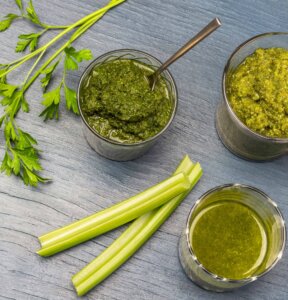
Celery leaves are perfect for making a flavorful and unique pesto, which is ideal when you're looking for a sauce that's a little different from the usual.
Wash and dry the leaves thoroughly, then blend them together with almonds or pine nuts, parmesan, extra virgin olive oil, salt and a few drops of lemon juice. If the mixture is too thick, add a little oil until you reach the desired consistency.
You can use celery leaf pesto to dress pasta, serve with croutons and bruschetta, or enrich vegetables, potatoes, and grains.
3. Crispy baked celery leaves
If you are looking for a fun idea, try turning celery leaves into a crunchy snack.
Wash and dry the leaves very well, then dress them with a drizzle of extra virgin olive oil, salt and pepper. Arrange them on a baking sheet without overlapping them and bake them in the oven at 180°C for a few minutes, checking them frequently: being thin, they can brown quickly.
Once crispy, you can serve them as a snack, use them to garnish soups and cream soups, or crumble them directly over your dishes to add an aromatic and crunchy touch.
4. Frittata with celery leaves
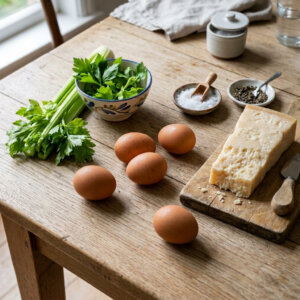
A simple idea for bringing celery leaves to the table is to use them to prepare a flavorful frittata.
Finely chop the leaves after washing and drying them. In a bowl, beat the eggs with grated Parmesan cheese, salt, and pepper, then add the celery leaves. Pour the mixture into a pan with a drizzle of oil and cook over medium heat until the frittata is well set. Flip it with the help of a plate and finish cooking on the other side as well.
You can enrich it with potatoes, zucchini, or other ingredients you already have on hand: a simple solution for creating a clean-out-the-fridge recipe and further reducing waste.
5. Vegetable broth with celery leaves and stalks
Celery leaves are also a valuable ingredient for making a good vegetable broth, especially when you want to make use of parts of the vegetables that normally risk being discarded.
Collect celery leaves and stalks, add carrots, onions, and any other vegetables you have on hand, and place everything in a pot with cold water. Slowly bring to a boil and let it simmer for about 40–50 minutes. Strain the broth and use it to make risotto, soups, or to cook grains and pasta.
It's a simple but extremely versatile recipe: you can also make a larger batch of broth and store it in the refrigerator to use in the coming days, or freeze it after dividing it into small portions.
A tip for Zero Waste
Even the ends of cucumbers and small trimmings left over during preparation can find new life in the kitchen. Add them to smoothies, juices, or infused waters along with lemon, ginger, and mint: you'll get a fresh and thirst-quenching drink, perfect for warmer days.
Also remember that if you use organic or well-washed cucumbers, the peel can become a valuable ingredient for many recipes, thus avoiding unnecessary waste.

More Zero Waste ideas and recipes
- The celery is the protagonist of our Cereal Soup, a Bontà Classic to be enjoyed all year round.
- Don't throw out the carrot peels: use them to prepare a sweet cake or a delicious hummus.
- I cabbage stalks black can be used to prepare a delicate pesto, perfect for flavoring a first course or topping a bruschetta.
- If you are looking for more recipes Zero wastes visit the dedicated section.
 Italian
  English
  Czech
Czech 


